
Stuff Verdict
The RedMagic 11 Pro delivers exceptional gaming performance with impressive liquid cooling and beastly specs, at a reasonable price.
Pros
- Standout liquid cooling system
- One of the most powerful smartphones available
- Incredible battery life, with fast charging to boot
- Large, bright, uninterrupted display
Cons
- Under-display camera produces poor selfies
- No telephoto lens limits keen photographers
Introduction
Ah, liquid cooling. Once reserved for the upper echelons of high-end gaming PCs and data centres, it’s now made its way into something far more pocketable. The RedMagic 11 Pro is the first smartphone with a closed-loop cooling system to banish heat – the enemy of processors and GPUs, especially in enclosed spaces – which should raise the eyebrows of anyone currently glued to Genshin Impact or Call of Duty: Mobile.
That’ll sound like overkill if your handheld gaming only extends to a daily Wordle round, but Destiny Rising and Diablo Immortal addicts will go gaga for the RedMagic 11 Pro’s dedicated haptic controller buttons, and what’s currently one of the most powerful spec sheets seen on a smartphone. The £629 starting price (around $825, though there’s no US launch planned) is then the icing on the cake. It seriously undercuts other flagships with Qualcomm’s newest silicon, like the OnePlus 15.
The question is whether the impressive hardware translates into a device you’d actually want to use on the daily – or whether inevitable compromises to the camera setup make this strictly for the mobile gaming faithful.
How we test smartphones
Every phone reviewed on Stuff is used as our main device throughout the testing process. We use industry standard benchmarks and tests, as well as our own years of experience, to judge general performance, battery life, display, sound and camera image quality. Manufacturers have no visibility on reviews before they appear online, and we never accept payment to feature products.
Find out more about how we test and rate products.
Design & build: bubblicious


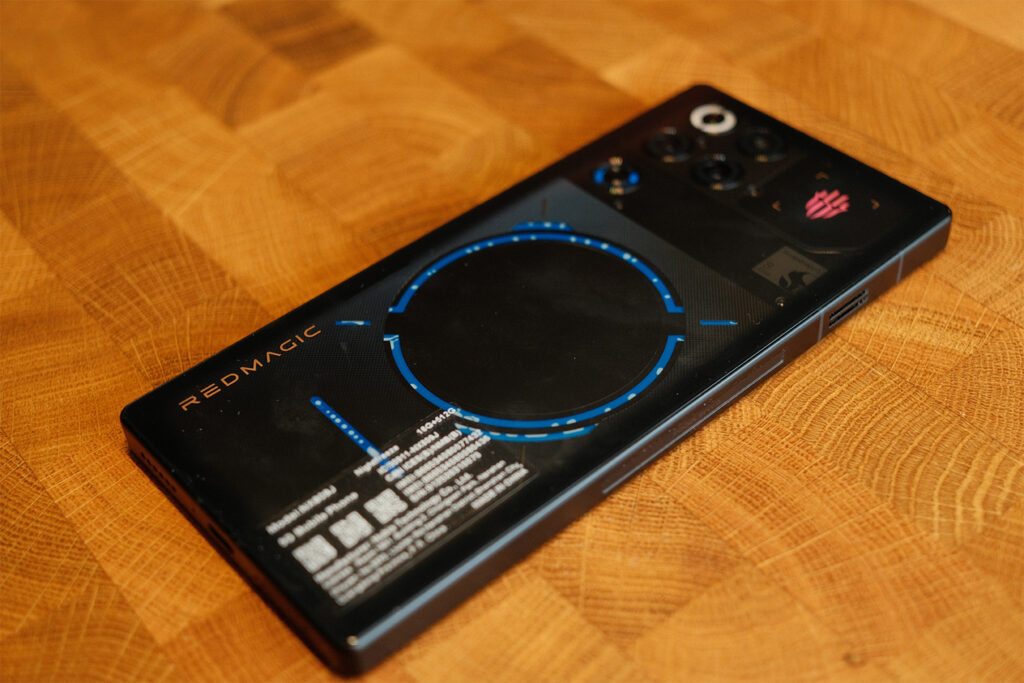
The RedMagic 11 Pro is immediately recognisable as a gaming device. The translucent black finish on the Nightfreeze model I’ve been testing artfully shows off an eye-catching circular liquid cooling window, complete with blue liquid coolant on full display. It’s distinctive without being embarrassingly flashy – though it’s definitely not subtle.
The rear panel, by the way, is completely flat, with no camera bump whatsoever. This makes it ideal to place on a desk or hold while gaming. The visible liquid cooling loop sits centrally, surrounded by polished and textured metal, a prominent Qualcomm Snapdragon logo, a RedMagic logo, and the firm’s signature active cooling fan.
It’s RGB illuminated, naturally, along with the logo, the capacitive shoulder triggers, and a new light strip along the side frame. You can customise everything or switch them off entirely. I went dark once the novelty wore off, having outgrown my RGB gamer phase years ago and preferring minimalism these days – but if you’re into that aesthetic, it’s there.
The flat aluminium frame also houses the usual array of buttons and a red slider switch; it activates Game Space by default, but I’ve used it to toggle the torch on and off. A 3.5mm headphone port is vanishingly rare on flagship-tier devices, but remains invaluable for those rocking wired gaming headsets, so RedMagic has kept one around here.
Warm air from the cooling loop is expelled out a vent in the side, but impressively the 11 Pro still carries an IPX8 rating. It should survive an accidental drop in the drink, but with no dust rating I’d advise extra caution at the beach or in dusty environments.
Screen & sound: no holes needed

The 11 Pro’s uninterrupted 6.85in AMOLED display is suitably top-tier, with the under-display front camera being almost impossible to spot and allowing for a huge 95.3% screen-to-body ratio. It’s an expansive canvas for gaming, multimedia, or general use, with a clear 2688×1216 resolution.
Variable refresh rate tech lets the panel tick up as far as 144Hz for silky-smooth scrolling and gaming. Left in automatic mode it seems to default to the highest setting most of the time, but you can choose between 60Hz, 90Hz, 120Hz, and the max 144Hz in the settings menus.
In practice, 144Hz makes everything feel fluid, from scrolling through social media to navigating intense firefights. You could eke out more battery life if you manually set it to a lower refresh rate, but given the incredible battery life on offer (more on that in a bit), I didn’t feel the need.
Elsewhere, RedMagic claims a peak brightness of 1800 nits, and in my testing, the screen remained perfectly legible even in bright autumn sunlight. Colours are vibrant, with the delicious punchy blacks that OLED fans crave.
On the audio front, the dual stereo speaker system delivers surprisingly robust audio. RedMagic has upgraded to a new speaker configuration for this generation, which provides more powerful bass, clearer sound quality, and a wider soundstage than the old mphone. Maximum volume is loud, and audio remains clear and well-separated even at high volumes, with only minimal distortion creeping in at the very top end. The bass response is also more substantial than most smartphones manage.
Cameras

Here’s where we encounter the RedMagic 11 Pro’s most significant compromises. Gaming phones have never been camera champions, and while RedMagic has made improvements over previous generations, this remains an area where mainstream flagships hold a considerable advantage.
The rear camera system has a 50MP main camera with a 1/1.55-inch sensor, optical image stabilisation, and an f/1.9 aperture. There’s also a 50MP ultra-wide with a notably smaller 1/2.88-inch sensor and 13mm equivalent focal length, and a third 2MP camera for macro shots. There’s no telephoto lens, which immediately limits versatility for anyone who regularly shoots subjects at a distance. As a fan of telephoto lenses and optical zoom, this is a pretty big omission for me.


In good lighting conditions, the main camera produces pleasant, realistic images with adequate detail. Colours are well-balanced without excessive saturation, and the OIS helps keep shots sharp. However, pixel-peep against images from a Google Pixel 10 Pro XL or iPhone 17 Pro Max, and you’ll notice less refined detail and somewhat flatter dynamic range.
The ultra-wide camera largely mirrors the main sensor’s colour science, which makes for consistent results when switching between the two. However, the smaller sensor struggles noticeably in anything less than ideal lighting. There’s also some distortion at the edges, though no worse than most ultra-wide implementations.


The absence of a dedicated telephoto camera means all zoomed shots rely on digital cropping. The results at 2x are acceptable thanks to the main sensor having so many pixels to play with, but venture to 3x or beyond, and image quality deteriorates rapidly. There’s aggressive processing to maintain a superficially clean look, but fine detail is simply absent. If you regularly shoot subjects at a distance, this is not the phone for you.
Low-light performance from the main camera is adequate rather than impressive. The sensor captures enough light to produce usable images, but noise creeps in more readily than on devices with larger sensors or more sophisticated computational photography. Night mode helps, though it requires a steadier hand and doesn’t quite match the best in class.


Video recording supports up to 8K resolution, though I’d recommend sticking with 4K at 60fps for the best balance of quality and file size. Stabilisation is actually quite good, and you can zoom while recording without switching lenses (since it’s all digital anyway). Colours remain realistic, though the image can look slightly flat.
Now, about that front camera. The 16MP under-display sensor is, to be blunt, not great by modern standards. In good lighting, selfies emerge soft and smeared. Colours often look slightly off, and there’s a general haziness to images.
In anything less than perfect lighting, results become poor. Low-light selfies are muddy and lacking in detail, with weird colour casts creeping in. The camera also struggles with bright backlighting, often rendering your face as an underexposed silhouette.


For video calls or the occasional casual selfie, it’s just about passable. But if you regularly take selfies or use your front camera for content creation, this will be a dealbreaker. The technology simply isn’t there yet – the uninterrupted display is great, but the camera quality compromise is real.
Having said all that, it’s still better than the Nubia Z70 Ultra’s equivalent (the only other under-display selfie camera I’ve personally used). I like the idea of an under-display camera, and am hopeful that the tech and algorithms will improve even more for future iterations.
In short, the camera system is good enough for a gaming phone, and is to be expected given that you’re paying primarily for raw power and gaming specs (not to mention, a beefy battery and a flat back). But if photography is a priority, you’ll be better served by virtually any other mainstream flagship.
Performance: feel the chill

With Qualcomm’s latest Snapdragon 8 Elite Gen 5 chipset and as much as 24GB of RAM, the RedMagic 11 Pro is one of the fastest smartphones you can buy at any price. The fact that you can nab these bleeding-edge specs for significantly less than £700, is incredible bang for your buck.
The 8 Elite Gen 5 brings CPU performance improvements of around 20% and GPU gains of approximately 30% over the previous generation – but stats only tell part of the story. What matters is sustained performance under load, and the RedMagic’s elaborate liquid cooling system keeps clock speeds at their peak no matter what you’re doing.
For those not in the know, liquid loops transfer heat from, say, a toasty processor more effectively than a passively cooled heatsink. In a gaming PC, the liquid passes through a radiator, where a fan blows out the excess heat before the cycle starts again; throttling – essentially your hardware taking the computational foot off the gas – happens when that heat has nowhere to go, resulting in worse performance, stuttering, or low frame rates.
This is overkill if you mainly doomscroll through social media, but during extended gaming sessions, the RedMagic 11 Pro maintained remarkably consistent frame rates. Games that might cause other devices to become uncomfortably warm and stutter after 20–30 minutes, ran smoothly here for hours. The phone stayed cool to the touch even during extended sessions, and performance remained consistently high.
While the tiny cooling fan is effective, it’s also quite loud once spun up to full speed. This isn’t a dealbreaker, but might catch you off guard before you realise the source of the noise.


For non-gaming tasks – browsing, social media, productivity apps – the RedMagic 11 Pro is almost comically overpowered. Everything feels instantaneous, and you’d be hard-pressed to make this phone stutter through normal use. Multitasking is effortless, and switching between dozens of open apps happens without the slightest hesitation.
The shoulder triggers provide useful additional inputs for gaming. They’re capacitive rather than mechanical, which means they don’t protrude or create awkward bumps, and they can be mapped to various functions within Game Space. They now support portrait mode gaming as well – something the last-gen model didn’t – which broadens their utility beyond landscape-oriented titles.


The RedMagic 11 Pro runs RedMagic OS 11.0, the company’s custom interface layered over Android 16. The interface uses a fairly stock Android appearance with some gaming-oriented flourishes.
Google Gemini is the default AI assistant, accessible via long-press on the home button or power button. Circle to Search is present, as are various Google-powered AI features, including real-time translation during calls, AI photo search, and image editing tools. These work well enough, though they’re Google’s implementations rather than anything specific to RedMagic.
Game Space remains the centrepiece of the software experience. Accessed via the red slider switch or through the app drawer, it provides a console-like interface for launching games, checking performance statistics, and accessing gaming-specific features. You can customise performance profiles per game, adjust display settings, configure the shoulder triggers, and access a vast array of plugins.
These plugins include features like screen recording, FPS counters, crosshair overlays, visual filters to make enemies easier to spot, audio enhancements to amplify footsteps, and even motion controls that let you trigger actions by physically tilting or shaking the phone. Some of these feel slightly gimmicky, but others – particularly the audio enhancements and visual filters – provide decent competitive advantages in the right hands.
Battery life: endurance athlete

The RedMagic 11 Pro’s 7500mAh silicon-carbon battery is, quite simply, enormous, and the longevity is remarkable. This is a phone you can game intensively on for hours, then still have enough charge remaining for a full day of normal use.
In my testing, which included a mix of gaming, media streaming, photography, browsing, and general use, I consistently achieved two days between charges. Even during deliberately punishing gaming sessions with the cooling system running, and all features enabled, the battery still saw me through till the end of the day without any fuss.
This is becoming the norm for phones not made by the Samsung, Google, and Apple, though, with Oppo and OnePlus both doing amazing things with capacity and longevity, so it’s not like this is your only choice of long-lasting flagship right now. Still, it’s up there with the best.
The included 80W charger isn’t the fastest around by Chinese phone brand standards, but it still comfortably puts the rest of the phone world to shame, hitting around 70% from zero in around half an hour. A full charge comes in at just under an hour.
More impressively, the RedMagic 11 Pro also supports 80W wireless charging. RedMagic claims a full wireless charge takes 68 minutes, which would make it one of the fastest wireless charging implementations available. I didn’t have an 80W wireless charger available for testing, so I can’t verify this independently, but it’s a welcome addition regardless.
RedMagic 11 Pro verdict

For gamers, there’s no denying the RedMagic 11 Pro’s appeal. You’re getting the fastest processor available, an elaborate cooling system that actually works, a gorgeous high-refresh display with no interruptions, enormous battery life, and thoughtful gaming features. The base model also represents exceptional value, while even the top-tier 24GB/1TB version still costs less than equivalent configurations from Samsung, Apple, or Google.
However, those camera compromises are significant. If photography is important to you – particularly selfies or telephoto shots – the RedMagic 11 Pro will frustrate. There are more traditional alternatives that are more well-rounded, with better photography, software polish, and overall refinement.
If you’re heavily into mobile gaming, want the absolute best best performance available – and are willing to accept camera and software compromises in exchange – then this unconventional flagship is worth your attention. For everyone else, it’s a fascinating technical showcase that’s still worthy of admiration.
Stuff Says…
A bold photographic powerhouse that dares to be different, offering flagship features at a midrange price.
Pros
Standout liquid cooling system
One of the most powerful smartphones available
Incredible battery life, with fast charging to boot
Large, bright, uninterrupted display
Cons
Under-display camera produces poor selfies
No telephoto lens limits keen photographers
RedMagic 11 Pro technical specifications
| Screen | 6.85in, 2688×1216, 144Hz AMOLED |
| CPU | Qualcomm Snapdragon 8 Elite Gen 5 |
| Memory | 12/16/24GB RAM |
| Cameras | 50MP main (f/1.9, OIS), 50MP ultra-wide (f/2.0), 2MP auxiliary rear 16MP front |
| Storage | 256GB/512GB/1TB |
| Operating system | Android 16 |
| Battery | 7500mAh w/ 80W wired/wireless charging |
| Dimensions | 164×77×8.9mm, 230g |